

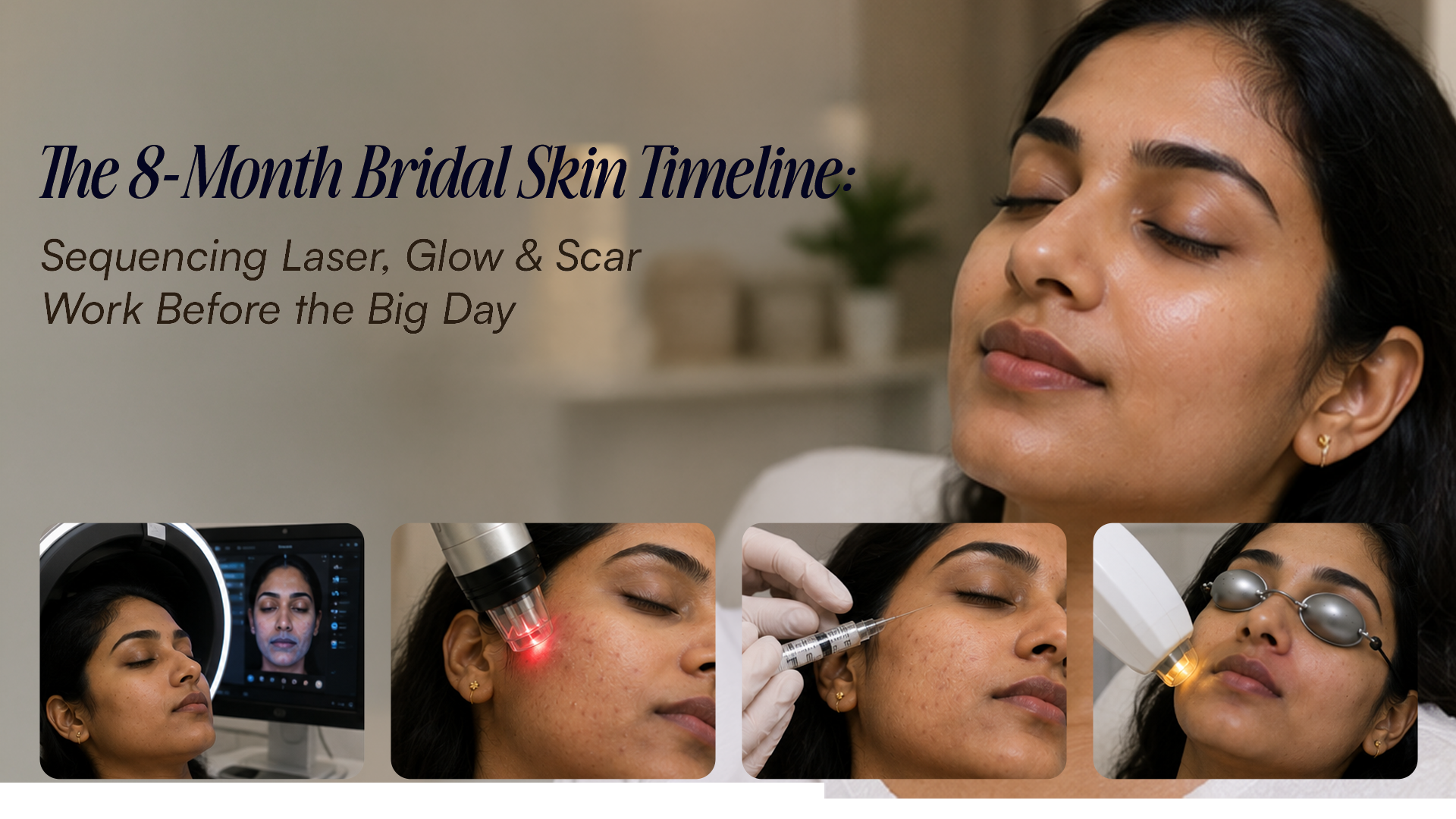
Most pre bridal skin treatment searches happen far too late. Somewhere around the one-month mark, panic sets in, and brides start booking whatever's available, a facial here, a peel there hoping something sticks before the wedding. The problem is, real skin transformation doesn't work on a rush timeline. Scarring needs months to properly resurface. Pigmentation needs multiple spaced sessions to fully clear. Structural work needs time to reveal its full result.
The treatments that actually move the needle need lead time, and the ones that give fast, camera-ready results should be saved for last. At VCare COE, this is exactly why bridal skin care is treated as a sequenced plan rather than a single appointment here's how that sequencing should actually look, worked backward from an 8-month starting point.
Month 8: Start With an Actual Skin Assessment
Before booking anything, the plan should start with understanding what your skin actually needs not guessing based on what worked for someone else. At VCare's Centre of Excellence, this starts with AI Skin Analysis, which maps pigmentation, texture, scarring, and overall skin condition before any treatment plan is built. Skipping this step is exactly how brides end up doing the wrong treatments in the wrong order, and it's the foundation every proper bridal skin care routine should start from.
Months 8 to 6: Address Scarring First and It Needs the Most Time
If you're dealing with acne scarring of any kind, this is the very first thing to tackle, simply because it needs the longest runway. VCare COE's approach for scar correction typically uses the Best Laser Treatment for Acne Scars, an ablative resurfacing laser that rebuilds collagen layer by layer. Most patients need 3 to 5 sessions spaced 4 to 6 weeks apart for optimal results, which means this phase alone can realistically take 2 to 3 months to complete properly. Starting it any later than month 6 genuinely risks running out of time before the wedding.
Months 6 to 5: Support Healing With Regenerative Therapy
While scar correction is underway, this is also the ideal window to introduce regenerative support that speeds up how your skin heals and rebuilds between sessions. VCare often layers in the Best Skin Repair Treatment a PDRN injectable derived from purified salmon DNA that works at a cellular level to activate collagen and elastin production, improve circulation, and support tissue repair. It's particularly useful for scars, dullness, and general skin fatigue, which makes it a natural companion to the resurfacing work happening at the same time, rather than something bolted on afterward.
Months 5 to 4: Correct Pigmentation and Tone
Once texture and scarring are on track, tone correction comes next. Pigmentation whether from sun exposure, hormonal shifts, or leftover acne marks needs its own dedicated sessions rather than being squeezed in as an afterthought. VCare's Laser Treatment for Pigmentation typically combines Q-Switch laser (for deeper spots and sun damage) with IPL (for surface tone and overall radiance), with most patients needing 3 to 6 sessions spaced 3 to 4 weeks apart. Doing this phase 4 to 5 months out gives your skin enough time to fully clear and even out well before wedding photography and videography.
Months 4 to 3: Bring In the Full Glass Skin Protocol
With scarring and pigmentation addressed, this is the point to bring in VCare's flagship Single Day Skin Transformation the 7L+3D=KB protocol that combines seven lasers with three dimensions of structural remodeling in a single extended session. Because this protocol's full results continue building over roughly 90 days, doing it 3 to 4 months before the wedding gives the structural and collagen-based improvements enough runway to fully mature by the big day, rather than being rushed. This phase is usually where the real bridal skin glow starts to show through, well ahead of the wedding date.
Month 2: A Texture and Radiance Touch-Up
With the heavier structural work behind you, month two is a good point for a lighter refinement session focused purely on texture and glow. Erbium Glass Laser is a non-ablative, low-downtime option well suited to this stage often described as a "lunch break" treatment because of how minimal the recovery is. It's less about correcting a major concern at this point and more about keeping skin looking consistently fresh as the wedding approaches, which is really the heart of any effective bridal skin treatment timeline.
Month 1: Fast, Visible Contouring Work
By the final month, it's time to shift toward treatments that show quick, visible results rather than ones requiring weeks to build. Jawline Contouring fits well here VCare's protocol often shows visible tightening after just one session, with most patients needing only 2 to 3 sessions spaced 4 to 6 weeks apart. For brides focused on how their profile looks in photos and videos, this final month is exactly when that kind of fast, structural refinement earns its place in the plan.
The Final Weeks: Protect What You've Built
By this point, the goal shifts from active treatment to simple maintenance sun protection, gentle skincare, and avoiding anything harsh or untested close to the date. This is also the point to book a final check-in, since even a quick assessment can catch small adjustments before the big day rather than after.
Best Bridal Skin Treatment: Why the "Best" Option Isn't a Single Treatment
A common question VCare COE hears is what the single best bridal skin treatment actually is and the honest answer is that no individual treatment fills that role on its own. The best bridal skin treatment approach is really the sequence itself: matching the right technology to the right stage of the countdown, rather than betting everything on one appointment close to the date.
Where This Plan Applies Across VCare's Locations
Brides working with a tighter regional search whether looking into a bridal skin treatment Bangalore option or a wedding glow package Hyderabad clinics might offer will find the same sequencing logic applies across all three VCare COE locations, since the underlying treatments and timeline don't change by city, only the clinic visited.
Why Sequencing Actually Matters More Than the Treatments Themselves
It's worth being honest about something here: none of these treatments are exclusive to bridal prep. They're the same technologies VCare COE uses for any skin concern, any time of year. What makes this genuinely a bridal skin treatment plan isn't the treatments it's the order and timing they're done in, built backward from a fixed date rather than treated as a loose wishlist. That's really the entire value of thinking about pre bridal skin treatment as a timeline instead of a shopping list.
A wedding date doesn't move, but most skin treatments need real time to show real results which is exactly why sequencing matters more than any single treatment on this list. Starting the conversation early with VCare COE is what actually makes the difference.
Book Skin Consultation at VCare's Centre of Excellence | Discover Vcare COE's Difference
Frequently Asked Questions
How far in advance should I start pre bridal skin treatment?
Ideally 6 to 8 months before the wedding, especially if scarring or pigmentation needs correcting, since those treatments require multiple sessions spaced weeks apart to show full results.
What does a proper bridal skin care routine actually involve beyond in-clinic treatments?
Alongside the sequenced treatment plan, a bridal skin care routine typically includes daily sun protection, gentle skincare that doesn't interfere with active treatment phases, and avoiding harsh or untested products close to session dates.
What if I only have 2 to 3 months before my wedding?
A shortened plan is still possible, but it usually needs to prioritize typically focusing on pigmentation correction and a single-day transformation protocol, while accepting that deeper scar correction may not have time to fully complete.
Which treatment should be done last, closest to the wedding?
Fast-result, low-downtime treatments like jawline contouring or a light Erbium Glass session work well in the final few weeks, since they show visible results quickly without needing time to build.
Is it safe to do multiple different laser treatments across several months?
Yes, when properly sequenced and spaced by a qualified team. This is exactly why an initial skin assessment matters it ensures each treatment phase is scheduled with enough recovery time before the next begins.
Can this timeline be adjusted for a groom or the wedding party as well?
Yes. While this plan is framed around a bride's timeline, the same sequencing logic assessment first, longer treatments early, fast treatments last applies to anyone preparing for a wedding on a fixed date.