

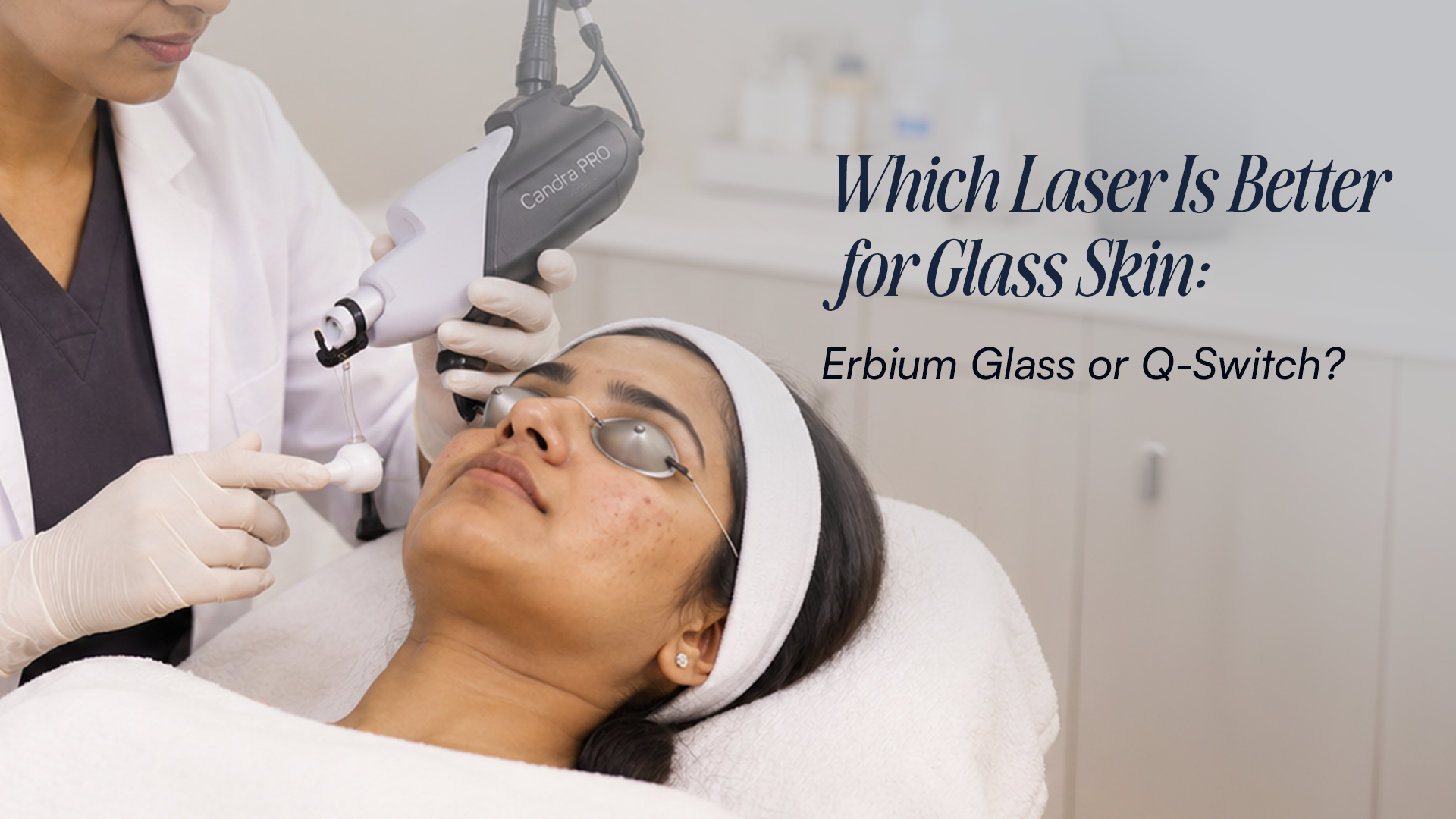
If you've spent any time researching glass skin, you've probably come across these two names again and again: Erbium Glass and Q-Switch. Both are laser workhorses in the world of Korean-inspired skincare, both get name-dropped constantly, and both promise that clear, luminous, camera-ready finish everyone's chasing. But here's the thing nobody quite explains clearly: they're not actually solving the same problem.
One works on your skin's texture. The other works on your skin's tone. And honestly, figuring out which one you need or whether you need both makes a real difference in whether you get the result you're after.
What Actually Makes Skin Look Like "Glass" in the First Place?
Before comparing the two, it helps to understand what glass skin really is. It's not one single quality it's a combination of things happening together: even pigmentation, smooth texture, tight pores, and enough hydration that light reflects off the surface evenly instead of scattering unevenly across bumps, dark spots, or roughness.
That's exactly why a single laser rarely gets the whole job done. Texture problems and tone problems come from different causes beneath the skin, which means they usually need different tools to fix.
Erbium Glass: The Texture and Rejuvenation Specialist
Erbium Glass is a non-ablative fractional laser, meaning it works underneath the skin's surface without actually breaking or removing the top layer. It uses a 1540nm–1550nm wavelength to send tiny, controlled micro-columns of heat into the deeper layers of your skin, which triggers collagen production and gradually improves firmness, tone, and texture from within.
Because it doesn't damage the surface, there's very little downtime involved you might notice mild warmth or slight pinkness right after a session, but that settles quickly. It's genuinely become known as a "lunch break" treatment for exactly this reason.
Erbium Glass tends to shine for concerns like dullness, fine lines, acne scarring, uneven texture, enlarged pores, and general skin laxity. Most people go through 3 to 6 sessions, spaced around 4 weeks apart, with results building gradually rather than showing up overnight.
If your main concern is texture, roughness, or that "tired" quality skin gets over time, this is generally the laser doing the heavier lifting. You can read the full breakdown of how it works on VCare's dedicated< a href="https://www.vcarecoe.com/erbium-glass-laser-treatment.php"> Erbium Glass Laser Treatment page.
Q-Switch ND:YAG: The Pigmentation and Brightness Specialist
Q-Switch works completely differently. Instead of targeting texture through heat and collagen stimulation, it uses ultra-short pulses of light tuned to specific wavelengths 1064nm for deeper pigmentation and vascular concerns, and 532nm for more superficial spots to break down pigment particles directly.
This is the laser people often refer to as the "Hollywood Peel," largely because of how quickly it can brighten and even out skin tone, sometimes with visible results after just one session. The mechanism here is almost mechanical rather than thermal; the laser essentially shatters unwanted pigment into tiny fragments that your body then naturally clears away over the following days.
It's particularly effective for sun spots, freckles, melasma, dullness caused by pigment buildup, and general skin brightening. Like Erbium Glass, most people need 3 to 6 sessions, usually spaced 3 to 4 weeks apart, though some brightening is often visible right from the first visit.
If tone, dullness, or pigmentation is your bigger frustration rather than texture, this is usually the laser worth prioritizing. VCare has a detailed page covering exactly how the Q Switch Laser Treatment works and what to expect from it.
So, Erbium Glass or Q-Switch : Which One Actually Wins?
Honestly? Neither wins outright, because they're not competing for the same job.
| Erbium Glass | Q-Switch ND:YAG | |
|---|---|---|
| Main focus | Texture, firmness, collagen | Pigmentation, tone, brightness |
| How it works | Heat-based collagen stimulation | Photoacoustic pigment breakdown |
| Best for | Fine lines, scarring, pores, laxity | Sun spots, melasma, dullness, uneven tone |
| Downtime | Minimal, mild warmth | Minimal, slight flaking of spots |
| Speed of visible results | Gradual, builds over sessions | Overall noticeable from session one |
If your skin issue is really about how it feels rough, uneven, aging Erbium Glass is doing the more relevant work. If it's about how it looks in terms of color patchy, dull, spotty Q-Switch is the one addressing that directly.
Can You Just Get Both?
This is actually where things get interesting, and it's a question VCare gets asked constantly. The truth is, glass skin rarely comes from fixing just one dimension of the problem. Most people who achieve that genuinely flawless, light-reflecting look are actually addressing texture and tone together, not choosing one over the other.
This is exactly the thinking behind VCare's 7L+3D Skin Transformation protocol, where both Erbium Glass and Q-Switch are used together as part of a larger, sequenced formula rather than as standalone, one-off treatments. Instead of guessing which laser to book, the combined approach treats both layers of the problem in a single, structured plan.
What About Pigmentation Specifically?
Since Q-Switch is really the laser doing the heavy lifting on tone, it's worth going a little deeper here. Pigmentation shows up in a lot of different forms: sun spots, melasma, old acne marks, general unevenness and not all of it responds the same way. VCare's approach usually starts with identifying exactly what type of pigmentation you're dealing with before committing to a laser plan, since melasma in particular tends to need more careful, customized settings than something like a simple sun spot. If pigmentation is your main concern rather than glass skin specifically, it's worth looking at VCare's broader Pigmentation page to understand the full range of options available.
And If You're Dealing With Acne Scarring Too?
It's also common for people chasing glass skin to be managing some acne scarring in the background, especially textural scarring left over from breakouts. Both Erbium Glass and, in more advanced cases, other resurfacing lasers get used for this, but scar correction usually needs its own assessment separate from general glass skin goals. VCare's Acne Scarring page walks through how that evaluation works if that's part of what you're dealing with.
Why This Isn't Really a Guess-Your-Way-Through-It Decision
Here's the honest truth: skin doesn't come with labels telling you exactly what's wrong with it. What looks like dullness could be pigmentation, could be texture, or could genuinely be both layered on top of each other. That's why VCare doesn't just hand out a laser based on what you think your problem is every plan starts with proper AI Skin Analysis to map exactly what's happening beneath the surface before recommending Erbium Glass, Q-Switch, or a combination of both.
Glass skin was never really about one miracle device it's about treating texture and tone as two different problems that happen to show up on the same face. Whether that means Erbium Glass, Q-Switch, or both working together, the right starting point is understanding what your skin actually needs before booking anything.
Book an Appointment | Discover Vcare's Centre of Excellence Difference
Frequently Asked Questions
Is Erbium Glass or Q-Switch better for glass skin?
It depends on the concern. Erbium Glass is better suited for texture, firmness, and fine lines, while Q-Switch is better suited for pigmentation, tone, and dullness. Most people working toward true glass skin benefit from addressing both.
Which one shows results faster?
Q-Switch often produces visible brightening after just one session, while Erbium Glass tends to build results more gradually over multiple sessions as collagen regenerates.
Can Erbium Glass and Q-Switch be done together?
Yes. In fact, combining both is fairly common, since they address different layers of the same overall goal. VCare's 7L+3D=KB protocol is built specifically around using both together.
How many sessions does each laser need?
Both typically require 3 to 6 sessions, spaced roughly 3 to 4 weeks apart, though this varies depending on the severity of the concern being treated.
Is there downtime with either treatment?
Both are considered low-downtime treatments. Erbium Glass may cause mild warmth or pinkness, while Q-Switch can cause temporary darkening or light flaking of pigmented spots as they clear.
Does Q-Switch work on melasma?
Q-Switch can help with melasma, but melasma tends to be more sensitive to laser settings than other forms of pigmentation, so it usually requires a more customized, carefully monitored approach.